📐 "Ensimmäiset 50 yrityskyselyä saavat mukautetun 3D-varaston suunnittelun" Suunnitelma
















Introduction
In modern warehousing, where order fulfillment speed directly impacts customer satisfaction, kuormalavahyllystöhas emerged as a game-changing storage solution. Unlike traditional static shelving, pallet flow racking systems leverage gravity to automatically move inventory forward, creating a seamless first-in, first-out (FIFO) workflow. This guide dives deep into why kuormalavahyllystö is the optimal choice for businesses looking to boost efficiency, reduce labor costsja maksimoida tallennustiheys.
For warehouse managers, logistics coordinators, and supply chain professionals, understanding how kuormalavahyllystö enhances operations is crucial. This article provides actionable insights, real-world applicationsja implementation strategies to help businesses make informed decisions.
1. Understanding Pallet Flow Racking: How It Works
1.1 The Mechanics Behind Pallet Flow Racking
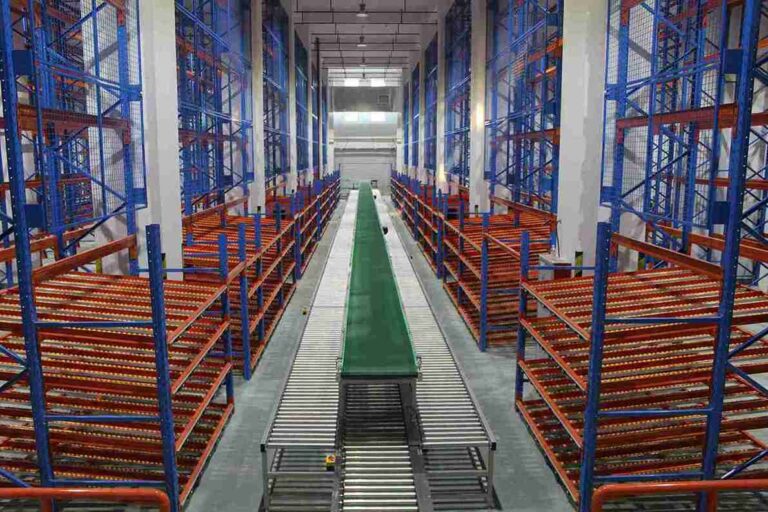
Lavavirtatelineet operates on a simple yet brilliant principle: gravity-driven movement. Pallets are loaded on an elevated end, then glide down inclined roller tracks tai wheel conveyors to the picking face. Key components include:
Rollers/Wheels: Engineered for smooth, controlled movement.
Braking Systems: Prevent pallets from gaining excessive speed.
Lane Dividers: Keep inventory organized in dedicated channels.
1.2 Types of Pallet Flow Racking Systems
Not all kuormalavahyllystö is the same. The right system depends on factors like kuormalavan koko, weight capacityja inventory turnover rate. Common variations include:
Standard Pallet Flow: Ideal for uniform loads in high-turnover environments.
Carton Flow Systems: Designed for case picking in e-commerce fulfillment centers.
Hybrid Push Back/Pallet Flow: Combines deep storage with FIFO efficiency.
2. Why Pallet Flow Racking Outperforms Traditional Storage Methods
2.1 Unmatched Order Picking Speed
In a conventional selective racking system, workers waste time navigating aisles and maneuvering forklifts. Lavavirtatelineet eliminates this inefficiency by bringing inventory directly to the picker. Studies show warehouses using kuormalavahyllystö experience 30-50% faster order processing.
2.2 Space Optimization: Store More in Less Space
Warehouses struggling with limited square footage benefit immensely from pallet flow racking’s high-density design. By utilizing deep-lane storage, businesses can double or even triple their storage capacity compared to standard shelving.
2.3 FIFO Compliance: Essential for Perishable Goods
Industries like food distribution, pharmaceuticalsja chemical storage require strict FIFO (First-In, First-Out) compliance. Lavavirtatelineet ensures older stock is always accessed first, minimizing waste and spoilage.
2.4 Labor and Equipment Cost Savings
Since kuormalavahyllystö minimizes forklift travel, businesses see:
Lower fuel and maintenance costs
Reduced labor hours (fewer workers needed for picking)
Extended forklift lifespan (less wear and tear)
2.5 Enhanced Workplace Safety
Manual pallet handling is a leading cause of warehouse injuries. Lavavirtatelineet reduces risks by:
Eliminating excessive lifting
Preventing pallet collisions with speed controllers
3. Industries That Gain the Most from Pallet Flow Racking
3.1 Food & Beverage Distribution
Ensures fresher product rotation
Reduces recall risks with better traceability
3.2 E-Commerce & Retail Warehousing
Accelerates same-day order fulfillment
Supports high-volume SKU management
3.3 Pharmaceutical & Healthcare Logistics
Maintains expiration date integrity
Complies with FDA and EU storage regulations
3.4 Automotive & Manufacturing Parts Storage
Streamlines just-in-time inventory replenishment
Reduces production line delays
4. Pallet Flow Racking vs. Competing Storage Systems
4.1 Pallet Flow vs. Selective Racking
| Ominaisuus | Lavavirtatelineet | Valikoiva hyllystö |
|---|---|---|
| Säilytystiheys | High (deep lanes) | Low (single-depth) |
| Access Speed | Fast (auto-rotation) | Slower (manual access) |
| Paras | Korkean liikevaihdon FIFO | Slow-moving SKUs |
4.2 Pallet Flow vs. Drive-In Racking
Drive-in racking uses LIFO (Last-In, First-Out), making it unsuitable for perishables.
Lavavirtatelineet on safer (no forklift entry required).
4.3 Pallet Flow vs. Push Back Racking
Push back racking allows deeper storage but complicates FIFO.
Lavavirtatelineet on simpler and more cost-effective for fast-moving goods.
5. Implementing Pallet Flow Racking for Maximum Efficiency
5.1 Warehouse Layout & Slotting Strategy
Fast-moving SKUs should be placed in high-velocity flow lanes.
Slow-moving items can use hybrid static/flow configurations.
5.2 Choosing Between Roller vs. Wheel Systems
Roller-based pallet flow racking: Smoother for lighter loads.
Wheel-based systems: Better for heavy-duty applications (e.g., automotive parts).
5.3 Integrating with Warehouse Technology
WMS (Warehouse Management Systems) for real-time tracking.
Automated replenishment triggers to prevent stockouts.
5.4 Employee Training Best Practices
Proper loading techniques to avoid jams.
Safety protocols for maintenance checks.
6. Overcoming Common Pallet Flow Racking Challenges
6.1 Preventing Pallet Jams & Misalignment
Ratkaisu: Install lane sensors and conduct weekly roller inspections.
6.2 Managing Heavy or Uneven Loads
Ratkaisu: Use reinforced steel rollers for weights above 3,000 kg.
6.3 Justifying the Initial Investment
Ratkaisu: Calculate ROI based on työvoiman säästöt ja increased throughput.
7. The Future of Pallet Flow Racking Technology
AI-Powered Predictive Maintenance: Sensors alert before failures occur.
Automated Pallet Retrieval: AGVs (Automated Guided Vehicles) working in tandem with kuormalavahyllystö.
Sustainable Materials: Recycled steel and energy-efficient designs.
Päätelmä
For warehouses seeking to dramatically improve order fulfillment, kuormalavahyllystö is not just an option—it’s a necessity. Its ability to accelerate picking, reduce operational costsja maximize storage space makes it the top choice for modern logistics.
Businesses ready to upgrade their storage systems should consult with a pallet flow racking specialist to design a customized solution that aligns with their workflow.
UKK
1. How long does pallet flow racking last?
With proper maintenance, pallet flow racking systems can last 15-20 years.
2. Can pallet flow racking handle unevenly weighted pallets?
Yes, but load distribution bars may be needed for stability.
3. What’s the ideal warehouse height for pallet flow racking?
Most systems work in facilities with clear heights of 20-40 feet.
4. Is pallet flow racking suitable for small warehouses?
Absolutely—compact pallet flow systems are available for tight spaces.
5. How does pallet flow racking impact insurance costs?
Many insurers offer discounts due to its safety advantages.