📐 "Ensimmäiset 50 yrityskyselyä saavat mukautetun 3D-varaston suunnittelun" Suunnitelma
















Introduction: Navigating the Critical Choice Between Two Heavyweight Storage Systems
The battle between double deep racking vs pallet flow racking represents one of the most consequential decisions warehouse operators face today. Both systems promise enhanced storage density, but they take radically different approaches to achieving it.
This in-depth comparison goes far beyond surface-level features, examining how each system performs in real-world warehouse environments. By analyzing operational workflows,cost structuresjaproductivity impacts, this guide provides the clarity needed to make an informed double deep racking vs pallet flow racking decision that aligns with specific business requirements.
H1: The Fundamentals: How Double Deep Racking and Pallet Flow Racking Work
H2: Double Deep Racking – A Space-Efficient Static Storage Solution
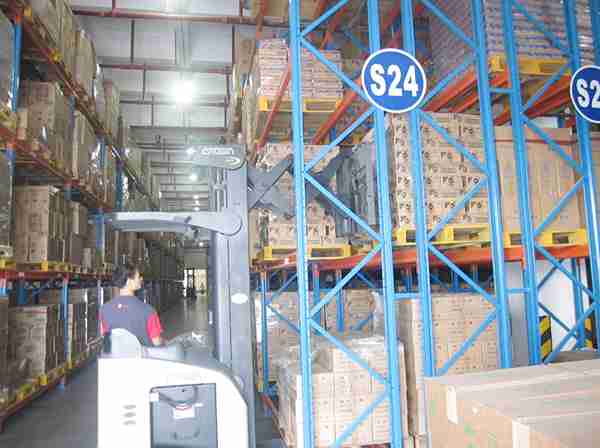
Double deep racking creates storage lanes that hold two pallets back-to-back, effectively doubling storage capacity compared to single-deep selective systems. This configuration requires specialized reach trucks with extended fork capabilities to access the second pallet position.
Key operational characteristics:
- Uses standard upright frames with deeper beam connections
- Requires 9-10 ft aisles for reach truck maneuverability
- Implements Last-In-First-Out (LIFO) inventory rotation
H2: Pallet Flow Racking – Dynamic Storage Through Gravity Power
Pallet flow racking transforms static storage into a continuous movement system. Pallets glide on inclined roller tracks from the loading to the unloading side, creating automatic product rotation perfect for FIFO inventory management.
Critical design elements:
- Angled roller beds (typically 3-5° incline)
- Sophisticated speed controllers and braking systems
- High-capacity structural supports for continuous load bearing
H2: Storage Density Face-Off: Double Deep Racking vs Pallet Flow Racking
H3: Square Footage Efficiency Comparison
| Metric | Kaksoissyvähyllystö | Lavavirtatelineet |
|---|---|---|
| Pallets/Sq Ft | 40-50% increase over selective | 60-75% increase over selective |
| Aisle Requirements | 9-10 ft | 12-14 ft (for loading/unloading sides) |
| Ideal Building Height | Up to 40 ft | 30 ft or lower for optimal flow |
H3: Real-World Density Scenarios
A 100,000 sq ft warehouse comparing double deep racking vs pallet flow racking:
- Double deep: Stores ~8,400 pallet positions
- Pallet flow: Stores ~11,200 pallet positions
- Selective (baseline): ~6,000 pallet positions
H1: Operational Impacts: Productivity in Double Deep Racking vs Pallet Flow Racking
H2: Picking Efficiency Analysis
Double deep racking introduces a 15-25% slower picking rate compared to selective systems due to:
- Additional maneuvering for rear pallet access
- Limited visibility of back pallet contents
- Reduced flexibility in SKU arrangement
Pallet flow racking maintains near-selective racking speeds because:
- Automatic product presentation at face position
- No forklift repositioning required
- Continuous product flow eliminates search time
H2: Labor Cost Implications
A detailed cost comparison over 5 years:
| Cost Factor | Double Deep | Lavan virtaus |
|---|---|---|
| Equipment Investment | $85,000 (2 reach trucks) | $120,000 (system + installation) |
| Labor Hours/Pallet | 0.25 | 0.15 |
| 5-Year Labor Savings | – | $375,000 (vs double deep) |
H1: Industry-Specific Applications: Where Each System Excels
H2: Double Deep Racking Champion Industries
- Automotive Parts Distribution
- Ideal for slow-moving components with long shelf life
- Compatible with bulk container storage
- Furniture Warehousing
- Accommodates oversized pallet configurations
- Cost-effective for seasonal inventory surges
H2: Pallet Flow Racking Dominant Sectors
- Food & Beverage Distribution
- Critical FIFO compliance for perishables
- Handles high SKU rotation (200+ turns/year)
- Pharmaceutical Logistics
- Batch tracking and expiration management
- High-volume vaccine distribution
H1: The Cost Equation: Analyzing Double Deep Racking vs Pallet Flow Racking Investments
H2: Upfront Capital Expenditure Breakdown
Double deep racking typically costs 120-180 per pallet position. However, the total cost picture requires deeper analysis:
5-Year Total Cost of Ownership
- Double deep: $58/pallet position/year
- Pallet flow: $42/pallet position/year
H2: ROI Timelines for Each System
- Double deep: 18-24 month payback period
- Pallet flow: 28-36 month payback period
H1: Hybrid Solutions: Blending Double Deep and Pallet Flow Advantages
Progressive operations are implementing mixed-strategy warehouses that combine both systems:
Optimal Hybrid Configuration:
- Pallet flow lanes for A-items (fast movers)
- Double deep storage for B/C-items (slower inventory)
- Selective racking for specialty items
H1: Future-Proofing Your Decision: Scalability Considerations
H2: Expansion Flexibility
Double deep racking offers easier reconfiguration:
- Additional bays can be added modularly
- Compatible with most warehouse management systems
Pallet flow racking requires more planning for growth:
- Flow lane extensions need precise engineering
- Throughput capacity must be pre-calculated
H1: The Verdict: Choosing Between Double Deep Racking vs Pallet Flow Racking
The final decision hinges on three critical factors:
- Inventory Velocity
- High turnover = Pallet flow
- Moderate/slow = Double deep
- Operational Budget
- Capital constraints = Double deep
- Labor reduction focus = Pallet flow
- Product Characteristics
- Perishable/FIFO = Pallet flow
- Stable/non-perishable = Double deep
H1: Frequently Asked Questions (FAQs)
H2: 1. Can existing forklifts be used with double deep racking?
Standard counterbalance forklifts cannot safely operate in double deep racking systems. Reach trucks with extended fork capabilities (minimum 96″ fork length) are mandatory.
H2: 2. What maintenance does pallet flow racking require?
Pallet flow systems need quarterly:
- Roller bearing lubrication
- Brake mechanism inspections
- Track alignment verification
H2: 3. Which system offers better damage prevention?
Double deep racking shows 30% lower product damage rates in most applications due to:
- Static storage environment
- Reduced handling movements
- Better load stability
H2: 4. How does seismic safety compare?
In earthquake-prone regions:
- Double deep racking requires additional bracing
- Pallet flow systems need motion-dampening modifications
H2: 5. What’s the maximum weight capacity difference?
- Double deep: Up to 4,000 lbs per pallet position
- Pallet flow: Typically 2,500-3,000 lbs per lane