📐 "أول 50 استفسار مؤسسي يحصل على تصميم مستودع ثلاثي الأبعاد مخصص" الخطة
















Introduction
Double deep racking systems are a game-changer for warehouses looking to maximize storage space. However, with increased density comes heightened safety risks—making strict adherence to OSHA standards for double deep racking absolutely critical.
This in-depth guide explores everything warehouse managers, safety officers, and forklift operators need to know about OSHA standards for double deep racking, including:
- Key OSHA regulations affecting double deep storage systems
- Forklift operation requirements under OSHA 1910.178
- Load capacity and weight distribution best practices
- Rack inspection protocols to prevent collapses
- Common violations and how to avoid costly fines
By the end of this guide, readers will understand how to optimize warehouse safety,stay fully OSHA-compliant, and reduce workplace accidents in double deep racking environments.
H1: Understanding OSHA Standards for Double Deep Racking
The OSHA standards for double deep racking are not explicitly outlined in a single regulation. Instead, OSHA enforces safety through:
- General Duty Clause (Section 5(a)(1)) – Requires employers to provide a hazard-free workplace
- ANSI MH16.1 & RMI Guidelines – Industry best practices referenced by OSHA inspectors
H2: Why OSHA Standards for Double Deep Racking Are Stricter Than Single Deep Systems
Double deep racking introduces unique hazards, including:
✅Higher risk of pallet dislodgement due to deeper storage positions
✅Increased forklift collision risks in narrow aisles
✅Greater difficulty in load retrieval, requiring specialized equipment
Because of these risks, OSHA inspectors pay close attention to double deep racking setups during warehouse audits.
H1: OSHA Standards for Double Deep Racking – Forklift Compliance
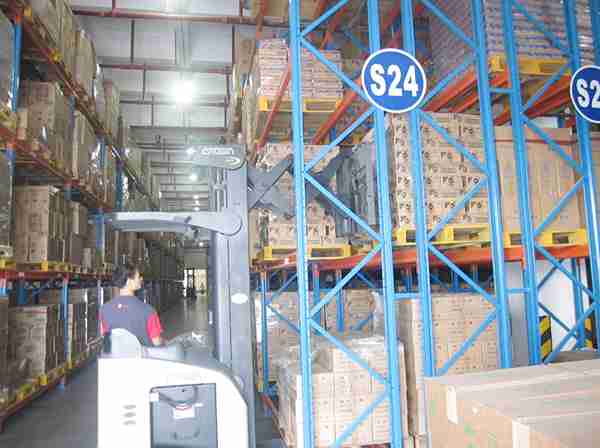
Since double deep racking requires narrow-aisle reach trucks, OSHA imposes strict forklift operation rules under 29 CFR 1910.178.
H2: OSHA-Required Forklift Features for Double Deep Racking
To comply with OSHA standards for double deep racking, forklifts must have:
✔Extended load backrests – Prevents pallets from tipping backward
✔Camera or RFID guidance systems – Ensures visibility of rear pallets
✔Automatic braking systems – Reduces collision risks in tight aisles
H2: Forklift Operator Training Under OSHA Standards for Double Deep Racking
OSHA mandates that all forklift operators must:
🔹 Complete certified training programs (including hands-on evaluations)
🔹 Pass written and practical exams specific to narrow-aisle operations
🔹 Receive refresher training every 3 years (or after an accident)
Failure to comply can result in fines up to $15,625 per violation (2024 penalty rates).
H1: Load Capacity & Weight Distribution Under OSHA Standards for Double Deep Racking
One of the most critical OSHA standards for double deep racking involves proper load management. Overloading or uneven weight distribution can lead to catastrophic rack collapses.
H2: How to Calculate Safe Load Limits
According to OSHA standards for double deep racking, warehouses must:
- Follow manufacturer load charts for each rack configuration
- Account for dynamic vs. static loads (forklift impact forces increase stress)
- Never exceed posted weight limits (clearly displayed on every bay)
H2: Common Load-Related OSHA Violations
🚫 Stacking pallets unevenly (heavier loads in the rear increase tipping risk)
🚫 Ignoring beam deflection limits (excessive bending weakens structural integrity)
🚫 Using damaged pallets (increases instability during retrieval)
H1: OSHA Standards for Double Deep Racking – Inspection & Maintenance
Regular inspections are a non-negotiable part of OSHA standards for double deep racking.
H2: Daily Warehouse Safety Checks
OSHA requires warehouse staff to:
✔Visually inspect uprights for dents, cracks, or bending
✔Check beam locks and connectors for looseness
✔Report any impacts immediately (even minor collisions can weaken racks)
H2: Professional Rack Audits Under OSHA Standards for Double Deep Racking
At least once per year, a qualified racking engineer must:
🔍 Conduct ultrasonic testing to detect hidden damage
🔍 Measure column plumbness (racks must be perfectly vertical)
🔍 Replace any compromised components (no temporary fixes allowed)
H1: Avoiding Common OSHA Violations in Double Deep Racking
Many warehouses fail inspections due to easily preventable mistakes.
H2: Top 5 OSHA Violations & How to Fix Them
- Missing Load Capacity Signs → Post visible ratings on every rack bay
- Untrained Forklift Operators → Require OSHA-compliant certification
- Damaged Racking Left Unrepaired → Implement a strict repair/replace policy
- Improper Pallet Placement → Train workers on correct double-deep loading
- Inadequate Aisle Widths → Follow RMI’s minimum clearance guidelines
H1: Best Practices for OSHA-Compliant Double Deep Racking
To exceed OSHA standards for double deep racking, warehouses should:
✅Install protective column guards to minimize forklift damage
✅Use only compatible forklifts (standard counterbalance trucks are unsafe)
✅Conduct monthly safety meetings to reinforce best practices
Conclusion
Complying with OSHA standards for double deep racking is essential for preventing accidents,avoiding fines, and maximizing storage efficiency. By following ANSI/RMI guidelines, ensuring proper forklift training, and conducting regular rack inspections, warehouses can create a safer, more productive work environment.
For further reading, visit:
- OSHA’s Warehousing Safety Guidelines
- RMI’s Rack Safety Manual
FAQs on OSHA Standards for Double Deep Racking
1. Does OSHA require special permits for double deep racking?
No, but warehouses must follow OSHA 1910.176(b) for storage safety and 1910.178 for forklift operations.
2. How often should forklift operators be retrained under OSHA standards?
Every 3 years or after an accident, per OSHA 1910.178(l)(4)(iii).
3. Can I repair a slightly bent rack upright, or must it be replaced?
Minor damage may be repairable, but severely bent uprights must be replaced per RMI standards.
4. What’s the penalty for violating OSHA standards for double deep racking?
Fines can exceed $15,000 per violation, with higher penalties for repeat offenses.
5. Are wire-guided forklifts required for double deep racking?
Not required, but recommended for improved aisle navigation and collision prevention.
By implementing these OSHA standards for double deep racking, warehouses can enhance safety,boost efficiency, and stay audit-ready at all times.